
Beginning Again
Rereading Scripture with a Beginner’s Mind and Two Small Details I Can’t Shake


Rob Wegner
There’s a particular kind of clarity that comes when you put your life into motion.
Maybe you know it too—the strange blend of excitement, exhaustion, anticipation, and vulnerability that comes with a move. Our recent transition to the Eastside of Kansas City has felt like that: a season of starting over and seeing familiar things for the first time.
Somewhere between unpacking boxes and relearning how long it takes to get to the grocery store, the bank, and the QT, and the unexpected joy of finding myself at home with new people and places, I’ve felt something deeper stirring as well. The Fox and Bull bakery has already become a weekly stop for what may be the best donuts in Kansas City. I now have a new favorite coffee shop in town, ASE. Gochew Korean-American smash burgers are, frankly, ridiculous. And art night with friends at Gnarly Hussle feels like a small but genuine glimpse of the new creation. The joy of deepening friendships and conversations here in our new hood has been a gift.
In the middle of all that, I’ve sensed a quiet invitation from Jesus that sounds something like this: “Begin again.” That nudge has led me to reread the Bible this year, starting at the beginning and reading with a beginner’s mind. Not because I’ve forgotten the story, but because Scripture contains endless treasures and surprises, and because our so-called expertise has a sneaky way of turning familiarity into something that feels like understanding without actually being it. The Spirit, it turns out, has a long-standing habit of reopening passages we were fairly certain were already highlighted, underlined, categorized, and put safely back on the shelf.
There are moments in Scripture that feel almost insignificant when you first notice them. Easy to skim past. Minor details with no footnotes or fanfare. And then, for reasons you can’t quite explain, they refuse to leave you alone.
As I reread Abraham’s story, two small phrases leapt off the page and have been quietly working on my soul ever since. I’ve been sitting with them, praying with them, holding them up to Jesus, to the wider arc of Scripture, and to our current moment. You’re welcome to decide whether this is spiritual discernment or a mild case of late-stage theological overthinking. Either way, I’m inviting you into the contemplation.
The first is Abraham living among the Philistines.
The second is a small, easily overlooked place called Zoar.
In Genesis 21, there’s a brief line I must have read a hundred times without really registering it: Abraham “lived among the Philistines” after making a treaty with their king.
That’s almost jarring when you know the rest of Israel’s story—a story that later casts the Philistines as the arch enemy: giants, wars, national struggle. And yet here, early in the biblical narrative, Abraham simply lives among them. He negotiates. He makes peace. He names a well. He calls on the name of Yahweh. He practices hospitality and is a living witness to the uniqueness of Yahweh.
Once I saw it, I couldn’t unsee it.
A Treaty Before Conflict
Think about that for a moment.
Abraham—the father of Israel—living with the Philistines. Not conquering them. Not displacing them. Not even in conflict with them. He has been sent, through what we might call the Great Commission of Genesis 12, to bless the nations. And he does so.
Later in Scripture, the Philistines become symbols of hostile power. But at the beginning, Abraham does not take land by force. He practices presence. He coexists. He blesses.
This shouldn’t surprise us. Genesis is not a conquest story; it’s a blessing story.
“I will make you into a great nation… and through you all the families of the earth will be blessed.” (Genesis 12)
That is not domination language.
It is mission language.
God’s way in the world begins with people, not over them. He comes to us as one of us, naked and crying, held by a teenage mother, dependent on her for everything. This King conquers by bearing a cross and wins by losing all. And then he sends his people into the world to do the same.
Martin Luther King Jr. would later articulate this same truth in moral language. I find myself rereading his words each year around MLK Day, drawn again to their clarity and courage. Power that dominates may impose order, but it cannot bring about justice. Justice, King insisted, grows only where human dignity is honored, not suppressed or ignored.
Jesus and the Undoing of Conquest Logic
That same thread runs straight into the Gospels.
Jesus repeatedly steps into places bound up with tribal memory and conquest logic—and quietly undoes them. He walks Galilee, a borderland. He stays in Samaria. He meets a Samaritan woman at Jacob’s well. He heals where walls once defined belonging.
He doesn’t retake ground the way many expected, as a Messiah calling down angels and overthrowing Rome. Instead, he dwells among the people, teaching in their synagogues, proclaiming the good news of the kingdom, and healing every disease and sickness (Matthew 9:35). He touches the untouchable, welcomes outsiders, and invests his life in a small band of disciple-makers.
One of the clearest places we see this is when we slow down and read two familiar stories side by side.
Jesus feeds two crowds.
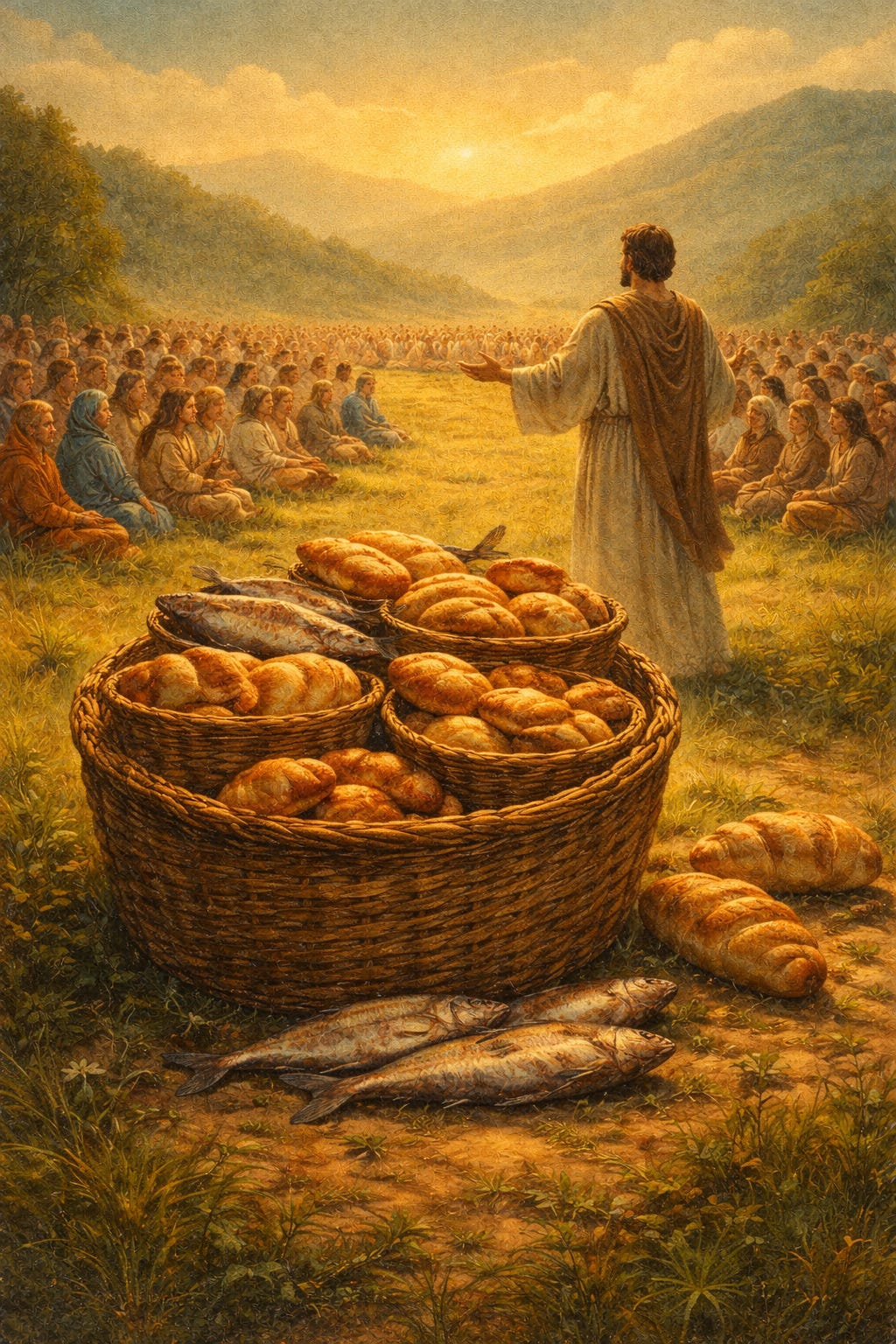
First, the feeding of the five thousand—a largely Jewish crowd. When the meal is over, twelve baskets remain. Twelve baskets. Twelve tribes. God’s provision for Israel.
Later, Jesus feeds the four thousand. This time, the setting points toward a Gentile crowd. When the disciples gather what remains, there are seven baskets left over.
Seven.
That number should give us pause.
In Deuteronomy 7, seven nations are listed, the peoples Israel was commanded to drive out as part of the conquest narrative. Seven nations once named as targets. And now…seven baskets left over.
Jesus takes the old “destroy the Canaanites” story and turns it completely on its head.
Instead of swords and spears, he brings bread and fish.
Instead of eradication, he leaves abundance.
Instead of conquest, he offers leftovers.
This is the same Jesus who shows mercy to a Canaanite woman when his disciples want to send her away. Without a sermon or manifesto, Jesus reframes the story.
The Kingdom of God does not advance by eliminating enemies.
It advances by feeding them.
From Commission to Movement
So when Jesus finally says, “Go and make disciples of all nations,” this is not a call to domination. Read through Abraham, through the feedings, through the cross—it’s a call to formation.
The Greek phrase panta ta ethnē doesn’t mean territorial takeover. It means peoples. Cultures. Communities.
Which is why Acts reads the way it does.
If you come to Acts expecting an empire, you’ll be disappointed. But if you expect a movement, suddenly everything makes sense. The church scatters not through force, but through witness. Not through conquest, but through presence.
Philip goes to Samaria. The Spirit falls on people once marginalized. In Antioch, believers are first called “Christians”—not rulers, but little Christs. Paul and Barnabas travel light, forming communities in homes, writing letters of encouragement rather than decrees.
Presence before power.
Blessing before dominance.
This is the same moral imagination Martin Luther King Jr. appealed to when he wrote that the church must never be the master or the servant of the state, but its conscience.
And then comes the second small biblical detail from Abraham’s story that I can’t seem to shake. Abraham pleads for mercy for Sodom and Gomorrah, negotiating with God with the persistence of someone haggling on a used car lot, slowly working the number down. Fifty? Forty-five? Thirty? Twenty? And finally, almost sheepishly, “Lord… what if there are just ten righteous?”
It’s a remarkable scene, not only for its boldness but for what it reveals about God and about us. Abraham’s intercession illuminates the wideness of God’s mercy, the real weight of intercessory prayer, and the quiet truth that a relatively small number of righteous people can have a preserving influence on an entire community. At the same time, the story reminds us that our collective decisions carry real moral weight. The rain of fire that follows echoes the rain of the flood earlier in Genesis, suggesting that God’s judgment in Scripture is never arbitrary or impulsive. It is often the moment when accumulated evil takes on a momentum of its own, when idolatrous rebellion hardens into a way of life that dehumanizes people and resists God at every turn. In that sense, judgment is not God lashing out, but God finally honoring what has been persistently chosen, “Remove Yourself from us.” And when God’s presence, protection, and provision are repeatedly refused, there comes a moment when God steps back. When that happens, the floodwaters rise. The fire falls. Not because God delights in destruction, but because a society has insisted on living without him.
Even then, mercy leads. The Lord sends messengers to pull Abraham’s family out of the city first. Rescue comes before reckoning. Mercy precedes fire.
Here comes the second gold nugget that has captured my contemplation these last few weeks.
Zoar: Mercy You Can’t Stay In
In Genesis 19, as Sodom collapses under the weight of its injustice, Lot hesitates. The mountains feel too far. Too costly.
So he asks for a small city nearby—Zoar. Close enough. Safe enough. Manageable. The negotiations begin again, “Look, here is a town near enough to run to, and it is small. Let me flee to it—it is very small, isn’t it? Then my life will be spared.”
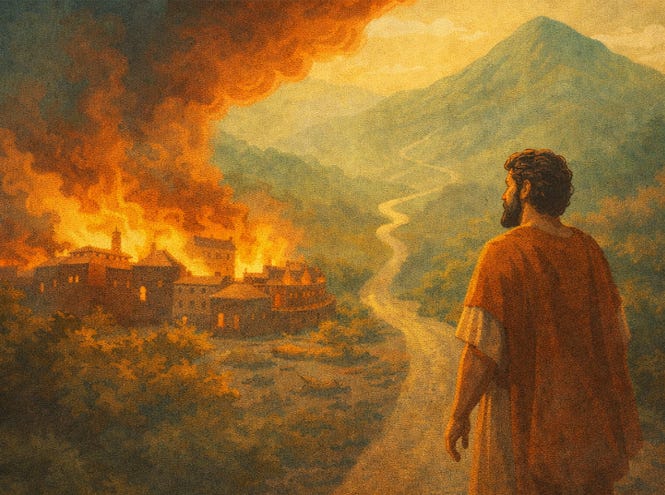
And God agrees.
Zoar is spared, not because it is righteous, but because God is merciful.
It is a refuge. A pause. A place to catch one’s breath.
But Scripture is clear: Zoar is not a place you can stay.
Eventually even Zoar becomes unsafe for Lot and his family. What began as mercy hardens into retreat. Refuge becomes avoidance.
Zoar isn’t evil at first.
It’s reasonable.
Cautious.
Tempting.
Zoar is where good people go—Lot and his family were, after all, the righteous being saved—when discernment and obedience feel too steep.
This is where Martin Luther King Jr. helps us see more clearly—not as a political symbol, but as a theologian of obedience.
His sharpest critique wasn’t aimed at extremists, but at moderates—those who preferred calm over conscience, stability over sacrifice.
Sounds a lot like Zoar.
Not cruel.
Not malicious.
Just unwilling to move when mercy demands motion.
This, King warned, was more dangerous than open hostility, because it dressed delay up as wisdom.
Minneapolis and the Language of Order
Which brings us—uncomfortably but unavoidably—to Minneapolis.
What we are witnessing there is not merely political unrest or media spectacle. It is a moral moment.
Scripture never celebrates violence. And yet Scripture is honest that unrest often erupts where accountability has failed and voices have gone unheard.
Disorder is not righteousness.
But order is not neutral.
King famously wrote that “justice too long delayed is justice denied.” His concern was never disruption itself, but complacency—the insistence on waiting when waiting only protects the status quo.
And this is where the question deepens.
Because moments like Minneapolis don’t just test our politics or policies. They test our theology. They reveal how we use Scripture, how we invoke God, and how easily sacred language can be pressed into the service of power rather than shaped by the way of Jesus.
Scripture, Power, and Coherence
That question sharpens when Scripture itself is invoked by power.
In recent Department of Homeland Security recruitment videos, Scripture verses have featured prominently—Isaiah’s call (“Here I am, send me”), Proverbs’ courage (“The righteous are bold as a lion”), and even Jesus’ words from the Sermon on the Mount: “Blessed are the peacemakers.”
I don’t raise this to score points. I raise it as a wisdom test.
Scripture is not fragile.
But it is demanding.
When Scripture is quoted by power, we must ask—gently but honestly—whether it still means what Jesus meant by it. Whether the way matches the words. Whether peacemaking looks like reconciliation…or enforcement cloaked in religious language.
Held alongside what is unfolding in Minneapolis—where federal immigration enforcement actions have resulted in deaths, detentions, and widespread fear—this question demands gravity and discernment.
As an evangelical Christian called to love my neighbor and honor the dignity of every person, I am deeply concerned by reports of lawfully present refugees being detained and interrogated by ICE agents. While it may be reasonable to re-examine specific cases where credible concerns exist, the collective punishment of refugees is antithetical to both American and Christian values.
Refugees are here at the invitation of the U.S. government. Before that invitation is extended, they undergo some of the most rigorous vetting of any category of immigrant—across multiple agencies. Many of those detained recently had already applied for lawful permanent residency, yet were taken from homes or public places and transported far from their communities.
Scripture refuses collective guilt. The prophets thunder against oppression. Jesus touches the outsider and welcomes the stranger. To wield Scripture in service of domination rather than dignity should give us pause.
It’s also why I want to invite you into deeper learning rather than quick judgment. World Relief is hosting a public town hall on refugees and ICE, designed to help people understand what is happening and how to respond thoughtfully and faithfully. You can learn more or register here:
https://discover.worldrelief.org/refugees-and-ice-townhall.
I trust World Relief—not abstractly and not merely institutionally. I’ve worked closely with their staff, including a deep partnership in southern India that gave us years together in shared work. I’ve seen their theological grounding, humility, and seriousness about both Scripture and people. For decades they have worked lawfully alongside government in refugee resettlement, serving some of the world’s most vulnerable with care and conviction.
If you’re looking for reasoned, biblically grounded counsel in this moment—rather than reactionary hot takes—I encourage you to listen to them in this season. Take a few minutes to read their recent press release condemning the detention of lawfully present refugees and to explore some thoughtful, constructive ways to respond as the Spirit leads.
It’s hard to know who to listen to right now. Facebook, as usual, is a dumpster fire. I hope you’ll tune your ear to their voice.
Whether we’re talking about enforcement operations that tear families apart or advocacy calling for humane treatment of newcomers, what’s at stake is deeply biblical: How do we live with people who are different from us? Who are outsiders? Who are strangers? Who are perceived as threats? These are not abstract questions; they are neighbor questions and they go to the heart of how we read Scripture and how we live as God’s people, calling us back to the original mission in Genesis 12.
Jesus didn’t call his followers to fortify borders or erect spiritual bastions of identity. He called them to bless all peoples. The early church didn’t bind itself to cultural dominance but scattered in witness and service.
Christian Nationalism vs. Kingdom Presence
There’s a temptation — perhaps perennial but especially potent now — to read the Great Commission through the lens of nation, identity, and political power. Some voices equate Christian faith with cultural dominance or political control. But that’s not the Jesus we meet in the Gospels, and it’s not the church we see in Acts.
In Acts, the people who first followed Jesus weren’t cultural elites or political strategists. They were ordinary people whose lives were fully integrated with their vocations — the seller of purple cloth, the jailer and his household. Their identity and their economy weren’t separate spheres. What Luke calls “the church” was really the oikos redefined. Families didn’t withdraw from society; they simply began living by a different set of values, now ordered by the Lordship of Jesus. And because their allegiance to Jesus was not separated from their economic life, they exerted real influence on the wider economy and the surrounding society. As we’ve noted elsewhere, Christians took in the sick during the plagues. They practiced hospitality in ways that shocked their Roman neighbors. This alternate way of life slowly, quietly transformed an empire.
The Jesus of Scripture is not a conqueror in a worldy sense. He is the crucified and risen one who heals divisions and gathers people across every boundary. He sends his followers into the world with presence, blessing, and hospitality — not conquest.
And as the Spirit invites us to begin again, we are called to live this out imperfectly but hopefully in our time:
loving strangers and immigrants as image-bearers of God,
resisting narratives that dehumanize our neighbors,
reimagining our civic and church life as participation in God’s mission of reconciliation,
and refusing to be swept up in any form of nationalism that equates faith with political dominance.
This is a movement marked not by exclusion but by embracing the other — by going to where people are, by being present among them, by blessing them, by forming life together in the way of Jesus.
Beginning Again (and Then Moving On)
And maybe this is what beginning again looks like in our moment.
Not certainty without listening.
Not zeal without wisdom, which has also marked many of the protests and responses.
But a willingness to test our instincts, examine our loyalties, and ask whether the places we’ve settled for safety have quietly become places we were never meant to stay.
Abraham among the Philistines.
Zoar as temporary mercy.
Jesus among Samaritans.
The early church among Gentiles.
Martin Luther King Jr. pressing the church beyond false peace.
The pattern is consistent: God invites us to begin again—but never to stay put.
Christian nationalism promises order through power.
The kingdom of God offers peace through presence.
This has always been a countercultural story. Jesus comes not as a conqueror but as a baby. And we cannot miss the significance of the King of the universe riding into Jerusalem on a donkey — a symbol in the ancient world of peace, not domination, in contrast to the warrior king who would have chosen a horse.
One conquers.
The other blesses.
So I’m sitting with these two small biblical details—Abraham’s treaty and Zoar’s refuge—and asking what they require of my own obedience right now.
You’re welcome to sit with them too.
With a beginner’s mind.
With open hands.
And with the courage to move when mercy calls us forward.
"Presence before power. Blessing before dominance." Very helpful commentary on those those two events in the lifetime of Abraham. When we consider that the biblical narrative insists that we're ALL off the same boat, how should we then live...in truth and love?
I think the writer is Rob Wegner. Thank you, Rob, for your insights today. I skimmed this post, but plan to return to it later today to digest more completely. Thank you for writing this. I learned your name by asking AI about who writes Starfishyou. 😀