
Before the Movement Moves
Extraordinary Prayer, Fasting, and the Hidden Seed of Multiplication

The Disciple-Maker Pathway, Part Two: PHASE ONE - EXTRAORDINARY PRAYER AND FASTING
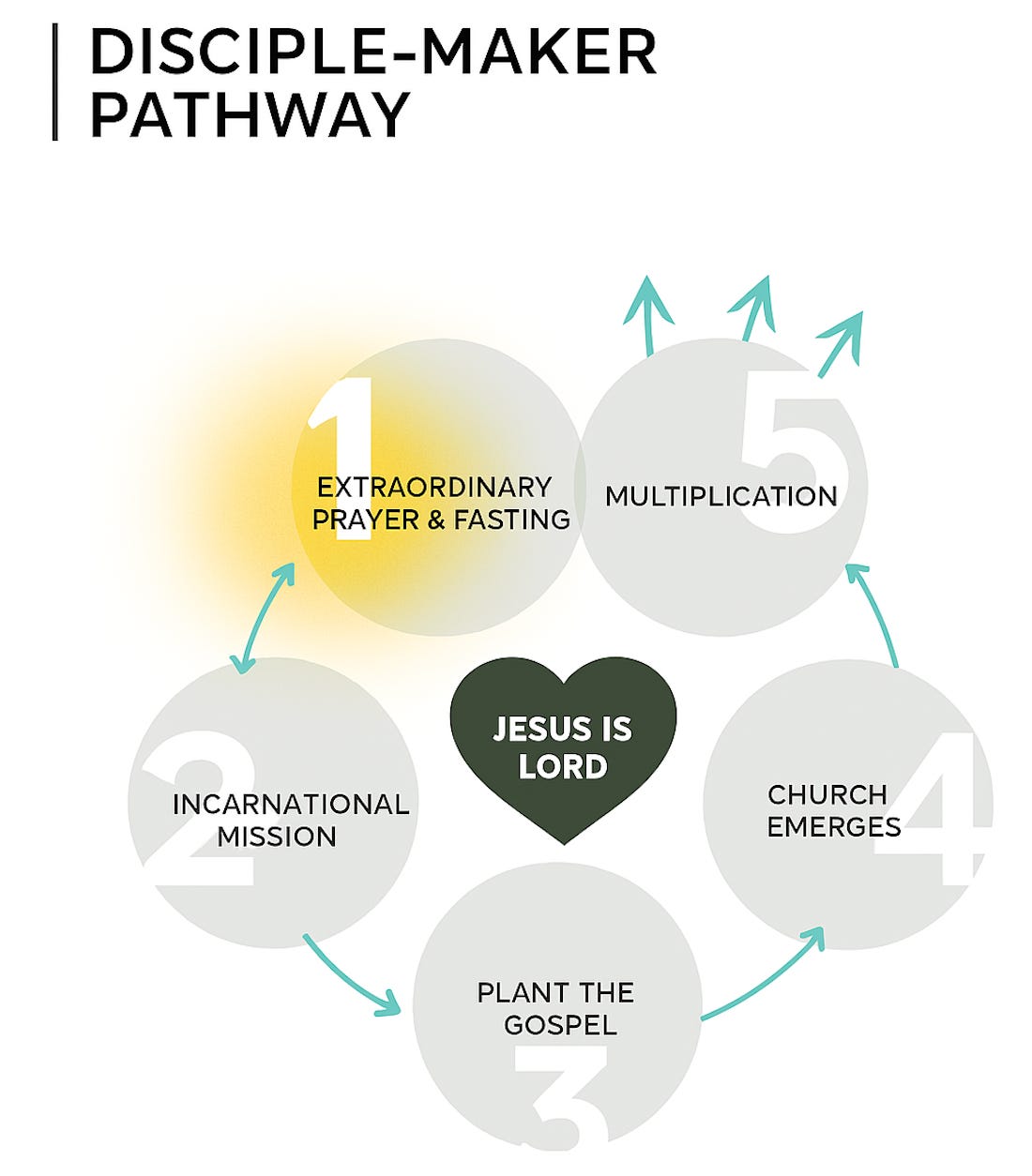
Every disciple-making movement in history has grown from the same sacred soil: prayer that refuses to move without God.
The “loudest” movements in history always starts in the silence of prayer.
We’re in a series journeying through The Disciple-Maker Pathway. It’s not a program to complete but a journey to inhabit; a way of seeing and a framework that helps ordinary people live as disciple-makers right where they are. For the Kansas City Underground, it’s our shared map for joining God’s redemptive movement across the city, and the way we organize our tools and training without losing our soul; keeping mission rooted in abiding.
In the last article, we traced how the Spirit redirected Paul’s map and redrew the Church’s boundaries; how one obedient “yes” by the river in Philippi became the birthplace of the first microchurch in Europe. Ordinary disciples, listening to an extraordinary God, stepped into the current of the Disciple-Maker Pathway: prayer, presence, proclamation, and multiplication.

Today we remember, before Jesus stepped into His mission, He chose the wilderness of fasting and prayer. Before the Church turned the world upside down, they sat still in the Upper Room. Before Paul and Silas ever set foot beyond Antioch, they listened and fasted until the Spirit spoke.
Now we come to the beginning of that same pathway in our own story, the place where every disciple-maker begins and every mature disciple-maker returns, again and again: Extraordinary Prayer and Fasting.
The Foundation: Prayer as the Work Itself
In the Kansas City Underground, Extraordinary Prayer and Fasting is Phase One of Disciple-Maker Pathway. It’s not a starting line we leave behind; it’s the river running beneath everything else. We never leave Phase One, it’s the undercurrent for all the following Phases.
We tend to think of prayer as preparation for the work of mission; Scripture reminds us prayer is the work.
Strategies can be helpful, but movements aren’t born from whiteboards and elbow grease. We can sketch great plans for our neighborhoods or networks, but if they flow only from merely human effort and wisdom, they’ll eventually drain us. They’ll distract us from what truly gives life. Every genuine movement and every spark of real momentum in our context begins with burning hearts, hearts set ablaze as we gaze upon Jesus in the posture of extraordinary prayer and fasting.
We can only move forward as fast as we can on our knees.
Prayer keeps us anchored in dependence on the Word and the Spirit. Before we launch plans, we listen for the Father’s voice. Without abiding, we risk mistaking adrenaline for anointing. The goal is never merely fruit; it is intimacy with the Vine.
There’s no pathway to multiplication without extraordinary prayer and fasting, because abiding in Jesus isn’t the first step toward movement. It is the movement itself.
Abiding Prayer: Returning to Jesus
Abiding prayer is simple and subversive. It’s not about getting more from God; it’s about getting more of God. We pause, listen, and surrender. We return—again and again—to the One who is our heart’s true home.
More than we want to be a disciple-making movement, more than we want to be a microchurch movement, we long to be a movement of abiding prayer.
This is metanoia in motion: repentance lived out as a continual reorientation of the heart and mind. It is learning to see as Jesus sees, to feel as He feels, to think as He thinks, and to move with Him through the world. Prayer becomes the conduit for this way of being.
Jesus often slipped away to lonely places, sometimes through the night, simply to be with the Father. Those moments were not detours; they were the engine of His ministry. From that hidden place of communion, He lived centered and free, saying only what the Father gave Him to say and doing only what the Father was doing.
We can live this way too. What would it look like for Jesus to inhabit my space and time, my home, my neighborhood, my work, my relationships? How do we become the kind of person who naturally does what Jesus would do right where we are?
When we pray like this, like Jesus did, something shifts within us. We find strength to stay tender in a hard world and courage to keep walking when the next step isn’t clear—which, in my experience, is most of the time. Because this life of prayer is far more about who we are becoming than what we are doing.
So what do we mean when we say, “when we pray like this”? What is the like this of extraordinary prayer and fasting?
What Do We Mean by Extraordinary Prayer?
Gallup polls show that most people admit to praying in some way at some time. That’s ordinary prayer. When we talk about Extraordinary Prayer, we’re describing something more than adding extra minutes to our quiet time. It’s not fundamentally just about praying HARDER and LONGER and LOUDER, although that will likely come as a side effect.
Extraordinary Prayer and Fasting is about a way of being that moves prayer from the margins to the center.
In the Kansas City Underground, we use a tool we call The Prayer Circles to help define what Extraordinary Prayer is. It’s a simple yet catalytic framework that awakens people to prayer at the ground level. It gives shape to extraordinary prayer and helps disciples cultivate three interconnected forms of prayer revealed in the Lord’s Prayer itself:
Contemplative / Listening Prayer
Contending / Missional Prayer
Practical Prayer
Jesus didn’t just give us words to recite in the Lord’s Prayer; He gave us a pattern that reveals the posture of the Kingdom.

Contemplative / Listening Prayer
“Our Father in heaven, hallowed be your name.”
When we begin in prayer, Jesus teaches us to start with both rest—“My Father”—and reverence—“Hallowed be your name.” That combination of intimacy and awe forms the foundation of what we call Contemplative Prayer or Listening Prayer.
Early efforts at prayer almost always revolve around talking and activity. Yet Jesus said, “My sheep listen to my voice” (John 10:27). Contemplative prayer helps us practice that listening, contemplative posture. It quiets the “monkeys in the tree” of our minds and tunes our hearts to the voice of the Shepherd.
The number one skill of any disciple-maker is to hear the voice of Jesus and respond in loving obedience. The goal of contemplative prayer is to learn to attune and attach to Abba, Jesus, and the Spirit. Without this, we have nothing.
This kind of prayer cultivates humility and dependence because we will never master it. We will always stumble forward, awkward and in awe, learning to rest in Presence rather than performance. Even the most mature disciple is still standing only at the edge of Narnia, with an eternity of wonder still ahead.
Over time, contemplative prayer shapes the essential muscles of incarnational mission as well: active listening, being fully present, and seeing through and into people and places rather than just at them. It forms the eyes and ears of love.
Contending / Missional Prayer
“Your Kingdom come… Forgive us as we forgive… Deliver us from evil.”
The second form of prayer is Contending Prayer, sometimes called Missional Prayer. This is where we move from inward listening to outward intercession—from breathing in to breathing out.
Contending prayer includes:
Intercession: Praying by name for people and places, standing in the gap on their behalf.
Declarative Prayer: Speaking blessing and authority in alignment with Jesus’ name and purpose. Like Peter at the Beautiful Gate saying, “In the name of Jesus Christ of Nazareth, get up and walk” (Acts 3:6).
Supplication and Lament: Honest, dependent prayers that confess our weakness and declare our hope: “We don’t know what to do, but our eyes are on You” (2 Chronicles 20:12).
Contending prayer is not about volume or bravado; it’s about agreement with heaven. It’s joining Jesus in His intercession for the world, participating in the unseen battle for hearts, neighborhoods, and nations. It’s where love gets its hands dirty.
Practical Prayer
“Give us this day our daily bread.”
This is Practical Prayer—the kind we all know instinctively. We ask for what we need: provision, wisdom, favor, protection. It’s simple, sincere, and childlike. Nothing is too small for the Father who counts hairs and holds galaxies.
We all begin here, but the goal is not to stop here. As the other circles expand, even our practical prayers begin to sound different. We start to pray for daily bread not just for ourselves but for our communities, our coworkers, our city.
The Circles Turn Together
At the end of a Prayer Circles training, we often ask people to draw three circles representing their prayer life.
Most draw a big circle for practical prayer, a smaller one for contending prayer, and then a tiny dot for contemplative prayer. That visual alone becomes a holy moment: an invitation to reimagine what a whole life of prayer could look like.
The goal isn’t balance; it’s integration. Over time, the circles begin to overlap until they become one. Contemplative (listening) prayer fuels contending (missional) prayer, which in turn infuses practical prayer. Eventually, the boundaries blur, and prayer becomes as natural as breathing…what Paul called “praying without ceasing.”

When the circles turn together, prayer becomes both anchor and engine, rooting us in God’s presence and propelling us into His mission.
Prayer in Coaching and Discipleship
As network and hub leaders, we must remember every committed disciple-maker and microchurch leader needs someone who prays for them. In coaching circles, prayer is the center point.
We describe coaching as the ministry of presence, questions, prayer, and perspective—offered over time, in love, for the sake of the mission.
When someone senses a new calling, we slow down to pray: “Jesus, where are You already at work, and how do we join You?” When leaders take new steps, we lay on hands and bless.
This is why the first rhythm in the BLESS framework is Begin in Prayer. Before we act, we attune. Before we speak, we listen. Before we lead, we love.
Corporate Prayer: The Family Gathers
Prayer is never just personal. It’s communal, embodied, and catalytic. The early church discerned direction together—with prayer and fasting. In a decentralized movement, unity doesn’t flow from hierarchy but from shared surrender.
In the Kansas City Underground, I look back and see cultivation of Five Coals of Extraordinary Prayer—five elements we’re learning to keep together, consistently stoked, and burning bright at the center of the fire.
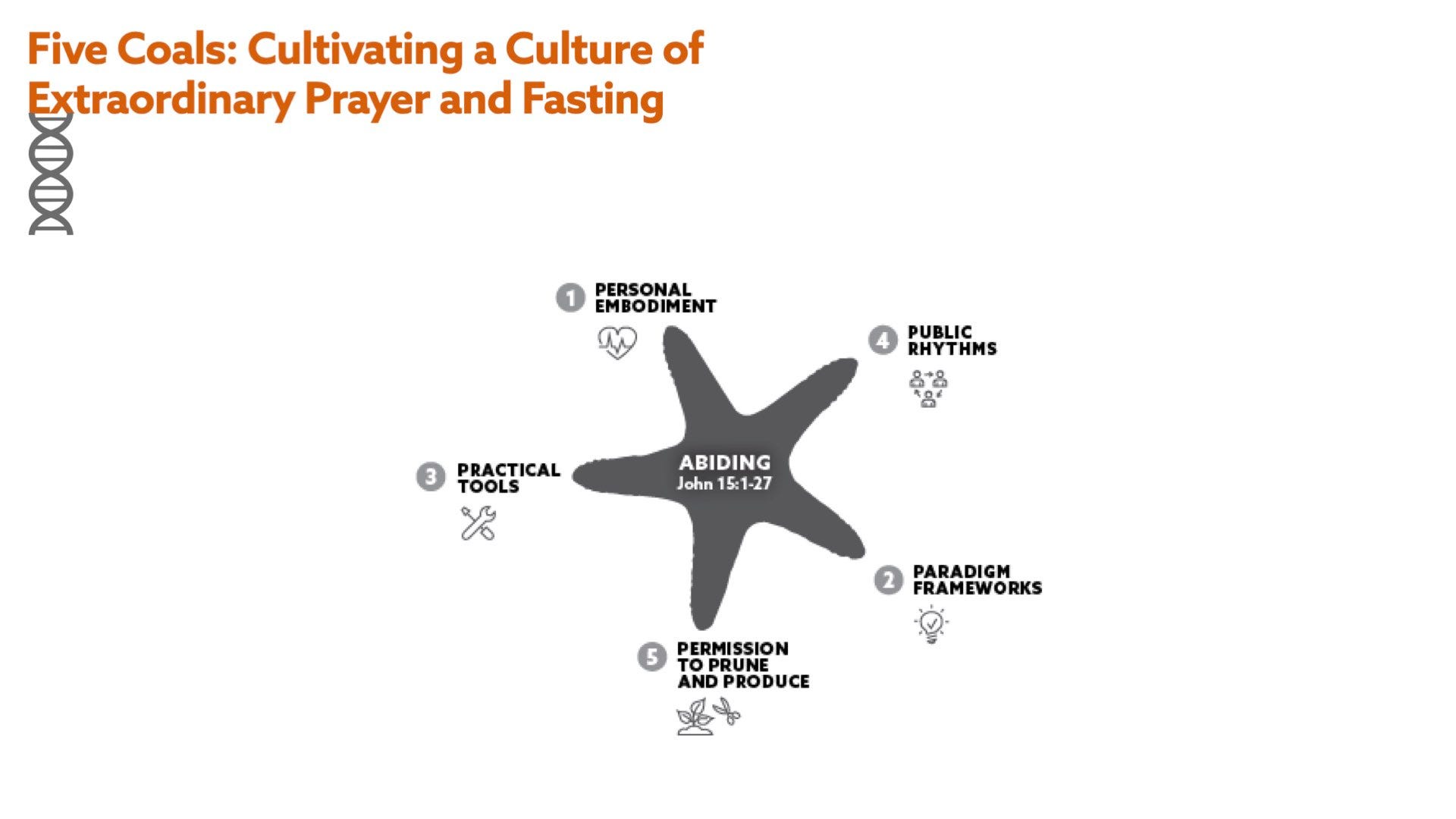
These coals include:
Personal embodiment, am I embodying what I am advocating in terms of a life of Extraordinary Prayer as a disciple-maker?
Paradigmatic frameworks, like the Missionary Pathway and Prayer Circles, which awaken ordinary disciples to extraordinary prayer and fasting.
Practical tools for prayer and fasting, simple enough for a twelve-year-old to practice and reproduce. We have a simple set of tools (Bless Five, Prayer of Examen, Listening Prayer, Welcome Prayer, Prayer Walking, etc.) to help people level up in Contemplative and Contending Prayer, as this is where we need the training. You can check those out in the Disciple-Maker Toolkit.
Public rhythms, where we weave prayer into the fabric of everyday life: early morning online prayer, weekly fasting rhythms, and quarterly city-wide gatherings through PrayKC.
Permission to prune, produce, and reproduce, allowing prayer rhythms, tools, and practices to prune and multiply at the pace of the Spirit’s leading.
These rhythms are how the family gathers. Together we fast, we intercede for our neighborhoods and networks, we discern prophetic direction, and we celebrate what God is already doing across the city.
If you’d like to go deeper into how these coals cultivate a culture of extraordinary prayer, you can read a fuller reflection here:

Fasting—especially when practiced together—recalibrates our appetites. It loosens our grip on control and opens our hands to receive again. Every coal adds to the flame, and together they keep the fire of movement burning bright.
The Lifeline of Rest
Jesus promised His followers an easy yoke, not an easy life. Prayer is how we learn the difference.
Through contemplative prayer, our breath slows, our minds settle, and our hearts remember who carries the weight. The government rests on His shoulders, not ours. Every time we return to silence, we remember that the world is not sustained by our effort but by His presence.
Silence also becomes a place of repentance. In stillness, we begin to see what has been hiding beneath our hurry. Many of us discover that what we once called drive was really anxiety in disguise, and what we called faithfulness was often exhaustion dressed up as devotion. Man, it took me a long time to wake up to that hard truth. Can I get a witness? Ha!
Practices like the Examen help us return to love at the end of each day, not through toxic shame, but through gratitude, conviction, and grace. We pause and ask:
Where did I notice Your presence, Lord?
Where did I resist You?
Where do I need Your grace tomorrow?
And even now, as you read this article, you might ask your own soul:
Where did I sense consolation—peace, warmth, nearness?
Where did I feel disconsolation—distance, distraction, resistance?
When did my longing for God increase?
When did I feel like hiding from Him?
This kind of quiet honesty re-roots us in love. Prayer becomes the lifeline that keeps us tethered to Jesus while we labor alongside Him. It reminds us that fruitfulness without friendship isn’t possible. Abiding always comes before activity.
Reflection for Hubs Teams and Microchurch Leaders
How central is prayer in the culture of our hub team or microchurch: foundational or functional?
Which circle of prayer needs renewal in our rhythm right now: contemplative, contending, or practical?
Which of the five coals of cultivating a culture of extraordinary prayer and fasting did the Holy Spirit highlight? Why?
How might we return to abiding before activity?
Looking Ahead
Next we’ll explore Phase Two: Incarnational Mission. This is where prayer turns into presence and presence becomes the birthplace of good news. Until then, may you find yourself drawn again to the quiet places. May you remember that before we build anything, we first behold Someone.

Thank you so very much for sharing both your heart for God and the world He so loves, as well as sharing in depth how you guys are becoming, going and making disciples of Christ!