
When Prayer Puts on Shoes
The Disciple-Maker Pathway, Part Three — Incarnational Mission: When Prayer Turns Into Presence

Brian Johnson
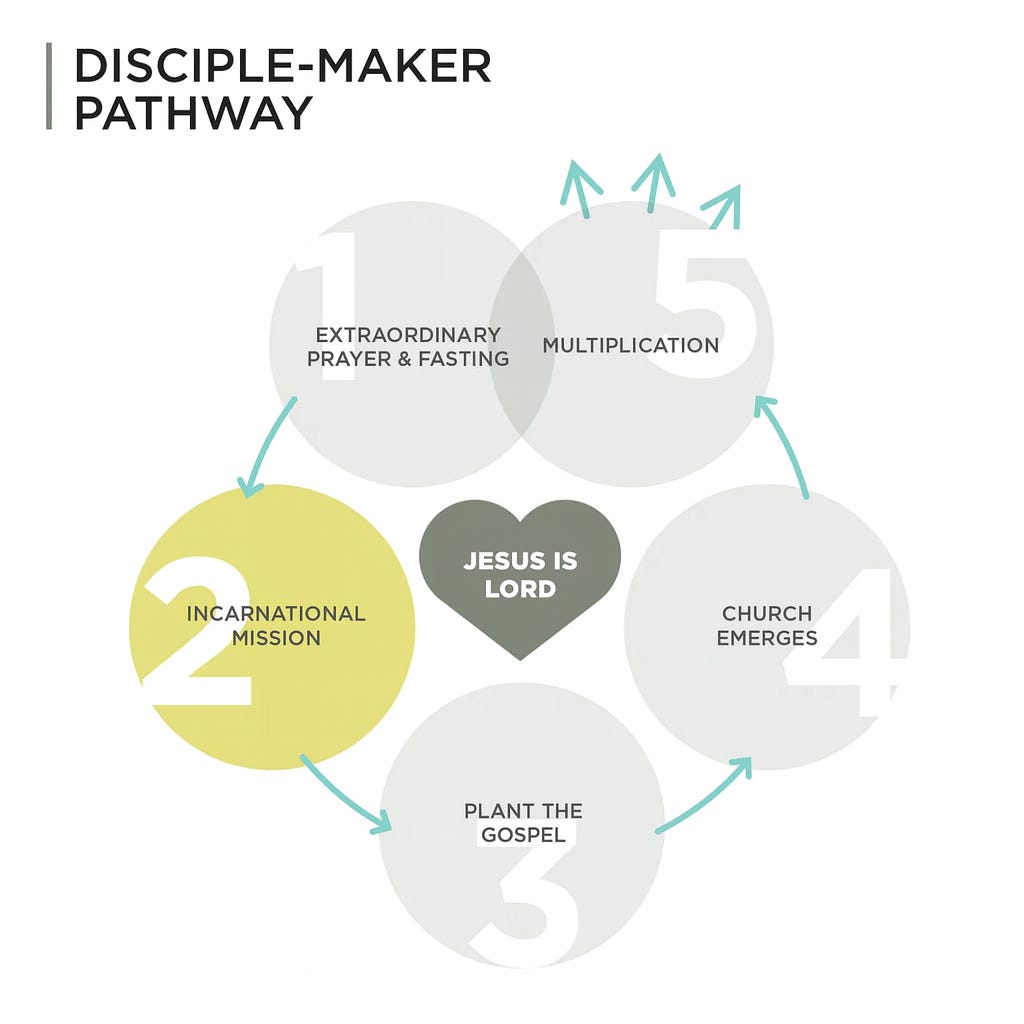
We’re walking on a journey together that we call the Disciple-maker Pathway. So many people have walked it before us. It’s the train that Jesus blazed for us.
In Article 1, we said the book of Acts isn’t ancient history; rather, it’s the Church’s operating system. Ordinary disciples listened to the Spirit, went where He said “over here,” and a household in Philippi became the beachhead for the gospel in Europe.
In Article 2, we said every movement worth remembering starts in the same soil: extraordinary prayer and fasting. Before the Church moved, she waited. Before Paul went, he listened. Before Lydia opened her home, God opened her heart. This is also the phase we never leave. It’s the phase that informs who we are and how we go forward in every other phase of the journey.
Now we come to the next bend in the pathway. This is the phase where prayer informs who we are and what we do “on mission.”
Phase Two is Incarnational Mission.
This is where the love of God that met us in the secret place now shows up on actual streets and around our tables as we get to know the names, stories, rhythms, hopes, and hurts of the people to whom Jesus has sent us. This is the phase where we learn the Kingdom is often seen before it is heard.
Before the Word Was Heard, It Was Seen
John tells us, “The Word became flesh and dwelt among us” (John 1:14).
As our friend Alan Hirsch would say, “Our Christology should inform our missiology.”
The Word didn’t commute. He moved in. He learned a language. He shared meals. He walked at the speed of relationship. He learned a trade. He had a career. He let proximity do its work.
Incarnational Mission is us doing the same thing in our context. We move toward people instead of waiting for them to move toward us. It’s the Spirit saying, “You’ve listened. Now go there. Stay there. Be there.”
Phase One without Phase Two becomes disembodied spirituality. Phase Two without Phase One becomes human activism.
The pathway keeps those fused: abide, then embody.
Who Am I Becoming? Incarnational Mission always starts here.
Before we talk about prayer walks, B.L.E.S.S., or context maps, we have to talk about the kind of person who does those things. Phase Two is not, “Great, five more tasks.” It’s, “This is actually who I am becoming in Jesus.”
Jesus said, “As the Father has sent me, I am sending you.” That wasn’t a bonus assignment for super-disciple-makers — it was Jesus handing us His own sent identity. Sent is now part of our name.
So the Phase Two question isn’t first, “What do I do?” It’s, “Who am I becoming?”
Am I becoming the kind of person who naturally moves toward people instead of away from them — even when I’m tired, even when it’s awkward?
Am I becoming the kind of neighbor others trust — someone steady, safe, and present, not sporadic and transactional?
Am I becoming someone through whom blessing flows, not just someone who has been blessed — a conduit, not a container?
Phase One (Extraordinary Prayer and Fasting) is where this starts. As we linger with Jesus there — in listening, in silence, in dependence — we begin to reflect Him. Prayer forms the inner life.
Phase Two (Incarnational Mission) is where all of that gets tested in the wild. Once we actually move into the neighborhood, office, school, or network, we find out: Do I look like Him here? Will I do what He did with the people He’s put in front of me? Incarnation is spiritual formation in public.
So we can press the questions a little further:
Am I becoming someone who is interruptible? Jesus let ministry happen on the way to Jairus’ house, through crowds, at wells. Mission rarely arrives on our calendar; it arrives as an interruption.
Am I becoming generous with my home, resources, and food? Incarnational people open their tables. Hospitality is mission on a plate.
Am I becoming patient with these people, in this place, at this pace? The Kingdom grows like yeast, not like a firework. Presence requires patience.
Am I becoming emotionally present enough to actually listen? Not just waiting to talk, but letting someone’s story rearrange how I love them.
Am I becoming non-anxious in my context? A person of peace in a hurried, angry, lonely world is magnetic.
Am I becoming someone who expects God is already at work before I arrive? That’s the Phase One mindset carried forward — “Lord, where are You already moving here, and how do I join You?”
That’s the heart of Phase Two: incarnation is character-forward. We don’t just bring tools into our neighborhood; we bring a transformed self. And the more we become like Jesus, the more natural it is to do what Jesus did — pray, listen, eat, serve, and share — right where we live.
Identity → posture → practices. Not the other way around.
Presence Before Proclamation
One of the big paradigm shifts for us in the Underground is this:
Think: planting the gospel in existing networks of relationships.
Don’t think: extracting people so we can disciple them somewhere else.
That’s what Jesus did:
Fishermen at their boats
Tax collectors at their tables
A Samaritan woman at her well
He met them where they were and let good news grow there.
Incarnational Mission, then, is slow, like yeast in dough. It’s staying put long enough for people to believe you actually love them. It’s letting your prayers from Phase One name actual faces in Phase Two.
From Becoming to Blessing
When identity starts to take root, it naturally grows fruit. Incarnational Mission isn’t about trying harder; it’s about letting who we’re becoming overflow into how we live. The inner work of formation (who I’m becoming) leads to the outward work of participation (how I join what God is doing around me).
When Jesus entered a town, His love always showed up in practical, relational ways. He prayed, listened, ate, served, and shared stories of the Kingdom. Those simple patterns were not his grand strategy. They were an outflow and expressions of His character.
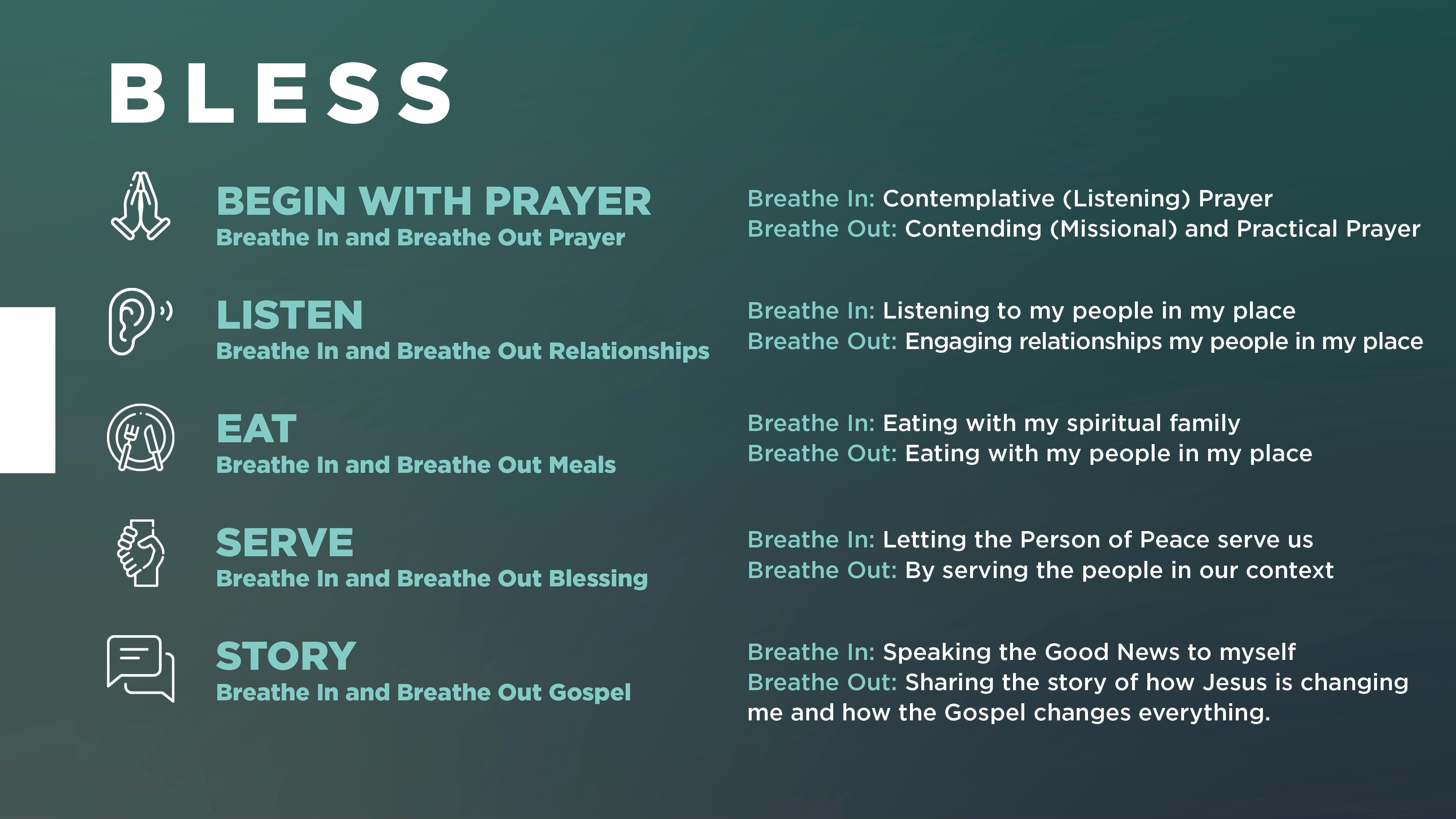
As we walk in His footsteps, we practice those same rhythms. In the Underground, we call them the B.L.E.S.S. rhythms. These are five simple habits that turn prayer into presence and presence into proclamation.
B – Begin in Prayer
We don’t leave Phase One behind; we carry it into the street. “Jesus, where are You already at work on my block, on this team, in this school, and how do I join You?”
L – Listen
Listening is love’s first move. We listen to God, to people, and to place. Most of us rush to talk; incarnational people get curious: “Tell me more.”
E – Eat
Tables are where strangers become friends and friends become family. Jesus “came eating and drinking.” We can, too. One meal a week with someone far from God will change your neighborhood over time.
S – Serve
We look for tangible, ordinary ways to demonstrate the Kingdom. This might be through rides, meals, childcare, or other ways to help a neighbor. Service is the apologetic of incarnational mission.
S – Story
Because presence eventually creates space for proclamation. When trust has been built and love has been seen, we share what Jesus has done in us and what He’s done for the world. Now, this is an invitation, not a pressure sell.
These aren’t five new church programs. They’re just normal life with Kingdom intentionality.
From Blessing to Belonging
When we live these rhythms consistently, something beautiful begins to happen, God starts revealing people of peace.
The B.L.E.S.S. rhythms are not just ways to “do mission”; they’re the soil where relationships of trust grow deep enough for the gospel to take root. Over meals, through small acts of kindness, and in ordinary conversation, you begin to notice hearts opening and homes welcoming.
That’s when the next movement of Phase Two comes alive: recognizing that God is already at work through people in your context.
In Luke 10, Jesus told the 72 to look for a person of peace — someone who welcomes, is open, and has relational influence.
We usually read that as, “I need to go find that person.”
That’s true. But, sometimes, in your context (your block, your CrossFit class, your school pickup line), you might actually be that person.
You’re the insider. You already speak the relational language. You already have trust. You already host. God may have placed you there to be the open door through which whole networks encounter Jesus.
So Phase Two is:
living hospitably,
staying non-anxious,
being a peacemaker,
and letting your home / schedule / table become Kingdom space.
When you live like that, the Spirit doesn’t just reach individuals, He reaches their oikos through you, just like He did with Lydia.
Tools That Keep It Local
To keep this from floating off into theory, we lean on simple, reproducible tools:
Context Mapping – name the places and people you’re already among.
Exegetical Prayer Walks – pray Scripture on location and pay attention.
Bless 5 – identify five households or people and pray blessing prayers over them consistently.
None of that is flashy. That’s the point. Incarnation is normal life made sacred.
Why This Phase Matters
It protects us from performative spirituality. Prayer that never lands in presence can get abstract and self-focused.
It keeps the gospel in real places. We want the Kingdom to show up in the Western Edge, Independence, Rock Island — not just in our centralized gatherings.
It makes disciple-making reproducible. Anyone can pray, listen, eat, serve, and tell story. You don’t need a mic. You need a life.
It sets up the next phase. Planting the Gospel (Phase Three) is so much easier in soil that’s already warm with relationship, and a bowl of White Chicken Chili.

From Practice to Discernment
Every phase of the pathway ends where it began: in prayerful reflection. As we live, listen, and love in our neighborhoods, we pause often to ask: Where is the Spirit already at work, and how are we joining Him?
Whether you’re part of a hub team, a microchurch, or a simple circle of disciple-makers, take a few moments together to reflect on what this phase is stirring in you.
Reflection for Hub Teams and Microchurch Leaders
As you listen together, consider these prompts:
Presence: Where are we actually embodied right now? Neighborhoods, networks, third spaces? Where are we still absent?
Pace: Are we moving at the speed of relationship or the speed of our calendar?
Rhythms: Which B.L.E.S.S. rhythm feels alive in us right now, and which one needs renewal?
Hospitality: Who among us is living as a person of peace right now, and how can we come alongside to strengthen that work?
Integration: How are we tying Phase One (Extraordinary Prayer) directly to Phase Two (Incarnational Mission) so they stay woven together rather than drifting apart?